Learning a language means learning to read another culture
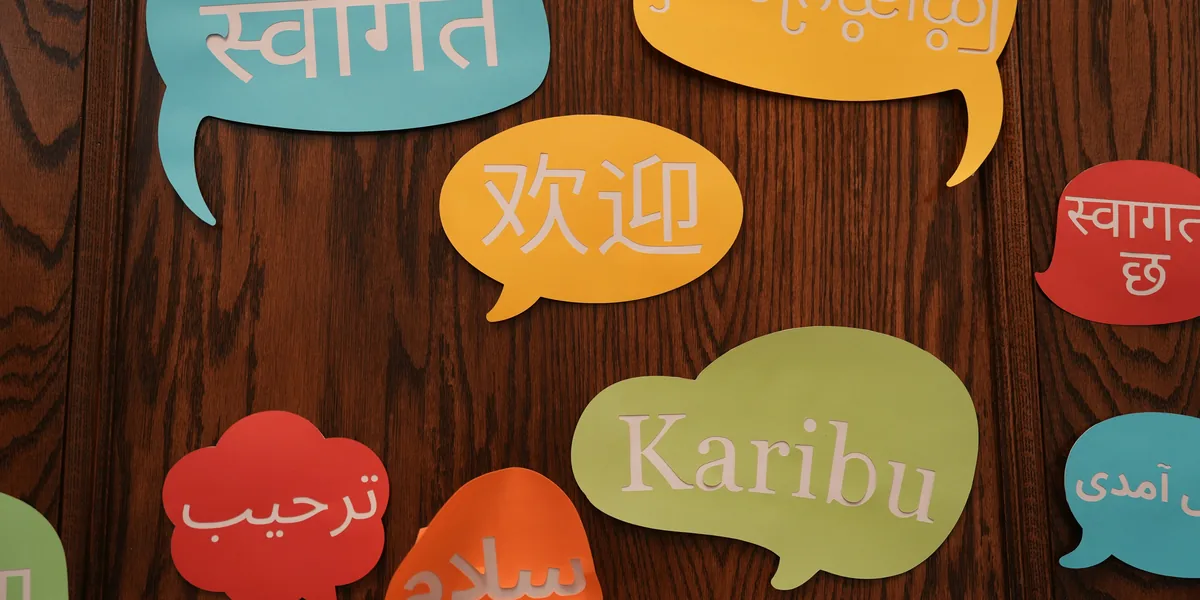
A contribution to our column Sguardi Educativi (Educational Perspectives), written for language teachers, educators and anyone who works with learners from different cultures. It reflects on what it really means to know a language, and why grammatical accuracy alone is not enough to communicate.
When you teach a language for many years, sooner or later you realise that the most interesting mistakes are not always grammatical ones.
A sentence can be formally correct, the words well chosen, the pronunciation clear. And yet something in the communication may not work. A request may come across as too direct, an answer as overly formal; a silence may be read differently from what we expected. Or we may understand every word of a conversation perfectly and still not fully grasp what is happening between the people speaking.
This is one of the aspects of language teaching I find most interesting, because it forces us to ask a question that only seems simple: what does it really mean to know a language?
Of course, it means knowing its vocabulary and grammatical structures, and learning to understand and produce it with growing competence. But over time, learners discover that this is not enough. Words do not exist independently of the people who use them and the situations in which they are spoken. Every speech act takes place within a relationship and carries conventions, expectations, references and implicit meanings that do not always match those of our own language and experience.
This is where language learning inevitably meets the cultural dimension.
A language is not a code to swap for another
One of the most common misconceptions is that learning a language means, at least at first, finding new words for concepts we already have. As if there were an almost perfect correspondence between one language and another, and the learner's task were mainly to replace one term with another.
Language teachers know how quickly this picture begins to show its limits. It is not only the words that change. The ways of addressing someone, of expressing agreement or disagreement, of making a request, of showing respect, closeness or distance may change too. So does the weight given to what is said explicitly and to what can be left unsaid. Even seemingly simple categories such as formality and informality take on different meanings depending on contexts and relationships.
This does not mean, of course, that every speaker represents a supposed «national culture». That would be precisely one of the stereotypes intercultural education should help us move beyond. Rather, it means recognising that communication is culturally situated, and that each of us interprets what we encounter through categories learned over the course of our own experience.
Learning another language also brings us face to face with these categories.
Learning to shift perspective
Language teaching has long reflected on this step. In the intercultural perspective proposed by Byram et al. (2002), language learning is no longer guided solely by the aim of conforming to a native-speaker model: what becomes central is the ability to relate different cultural perspectives to one another, interpret them, and question one's own point of view as well.
From this perspective, intercultural competence does not consist in accumulating information about «what Italians, Russians, Germans or the English are like». Teaching built this way would risk replacing the complexity of culture with a repertoire of assumed behaviours and, very often, of stereotypes.
The most interesting work begins instead when students learn to ask themselves why a particular situation strikes them as natural, unusual, polite, cold, direct or ambiguous. At that point they are no longer just observing the other: they begin to realise that their own way of interpreting the world is not neutral either.
I believe this is one of the most profound shifts that learning a language can bring about.
No one enters a new language empty-handed
There is another aspect that teaching experience makes particularly clear: when we start studying a new language, we never really start from zero.
We bring with us the language or languages we already know, naturally, but also communication strategies, experiences, habits, associations and ways of organising what we see.
Research on plurilingualism has gradually moved beyond the idea of languages as completely separate compartments. In their study on valuing linguistic and cultural diversity, Coppola and Moretti (2018) show, also through a classroom experiment, how productive it can be to work on learners' linguistic repertoires, on comparison between languages and cultures, and on metalinguistic and intercultural reflection.
This perspective also changes the teacher's role. The linguistic and cultural knowledge students already have is not necessarily interference to be eliminated: it can become material to work with.
Comparing does not mean deciding which language is more precise, richer or more effective. It means noticing the choices each language makes available, and observing what happens when we try to transfer words, formulas or behaviours automatically from one communicative system to another.
Sometimes understanding begins precisely in that small friction.
Different contexts, the same question
In my work I have encountered this dynamic in very different situations: teaching teenagers and young people, working with adult learners, teaching Italian as a second language, and in language training linked to professional needs.
Goals, materials, timeframes and motivations change, and so, of course, do the ways of working. But the same need keeps returning: helping learners understand not only what to say, but also what is happening in the situation in which that language is used.
For a teenager, it may emerge while reading a dialogue or encountering a text that challenges categories taken for granted. For someone learning Italian as a second language, it may concern everyday situations, social relationships, or how to interpret behaviours that at first seem hard to read. In a professional context, it may surface in a phone call, a meeting, or a request made to a colleague or a client.
Linguistic competence remains essential. But accuracy alone does not guarantee that communication achieves its purpose.
From knowledge to action
The Common European Framework of Reference for Languages has also gradually moved in this direction. In the Companion Volume (Council of Europe, 2020), the learner is seen as a social agent who uses their linguistic and cultural resources to act, collaborate, understand and mediate.
This perspective is particularly significant because it shifts attention from what a person «knows» about a language to what they can do through that language together with others.
If we take this idea seriously, the lesson changes too.
Grammar does not disappear, nor does it lose importance. Vocabulary is still studied, mistakes corrected, structures consolidated. But alongside this there must be room for situations in which students can observe, compare, form hypotheses and interpret what is not immediately obvious.
An authentic dialogue, a different wording of the same request, an image, a scene or a text can become opportunities to ask not only «what does it mean?» but also «why is it said this way?», «what is the relationship between these people?», «would I have said the same thing in the same way?».
The teacher's task, then, is not to explain to students how another culture thinks. No culture thinks with a single voice. It is rather to give them tools to question what they encounter, recognise complexity, and accept that not everything can be translated straight into the categories they already have.
Reading beyond the words
Literary texts can play a particular role in this process. Not because they offer an objective snapshot of a society (literature is not a manual of cultural behaviour), but because they allow us to enter situations, relationships and conflicts through language.
A character who speaks, falls silent, misunderstands or judges forces us to interpret. Literary texts thus make especially visible the gap that can exist between understanding words and understanding a situation.
This theme deserves a reflection of its own. But it brings us back to the question we started from: what does it really mean to know a language?
It certainly means learning words, structures and rules and being able to use them with growing autonomy. But it also means learning to recognise contexts, relationships and points of view; noticing our own interpretive automatisms, and discovering that what seems obvious to us is not necessarily so for the person in front of us.
Learning a language, then, does not only mean finding new words to say what we already know. It also means discovering that the world can be read from another point of view.
English translation by Starry Mind Academy, reviewed and approved by the author. Read the original Italian version.
References
- Byram, M., Gribkova, B., & Starkey, H. (2002). Developing the intercultural dimension in language teaching: A practical introduction for teachers. Council of Europe.
- Coppola, D., & Moretti, R. (2018). Valorizzare la diversità linguistica e culturale. Uno studio di caso [Valuing linguistic and cultural diversity: A case study]. In C. M. Coonan, A. Bier, & E. Ballarin (Eds.), La didattica delle lingue nel nuovo millennio. Le sfide dell'internazionalizzazione [Language teaching in the new millennium: The challenges of internationalisation] (pp. 397–412). Edizioni Ca' Foscari. https://doi.org/10.30687/978-88-6969-227-7/024
- Council of Europe. (2020). Common European Framework of Reference for Languages: Learning, teaching, assessment. Companion volume. Council of Europe Publishing.
Cristina Moretti
Teacher of Russian language and literature and of Italian as a second language
For many years she has taught languages to teenagers, young people and adults, both in schools and in individual and training programmes. Her work focuses on language teaching and on Russian literature and culture, with particular attention to the intercultural dimension of learning.
She is the creator of Ponti d'Inchiostro, a literary and cultural project encompassing a newsletter and podcast. On Instagram, she publishes under her professional name, Cristina Moretti, focusing on books, literature and culture, with particular attention to Russian literature.
Column · Sguardi Educativi
The Starry Mind Academy space for the voices of education and care professionals: experiences, practices and reflections that broaden our view of the complexity of educational processes.
Are you an education or care professional and would you like to propose a contribution? Write to us.
Contribution subject to editorial review. The opinions expressed are those of the author and do not necessarily reflect the position of Starry Mind Academy. How we work