Marco Ripà: learning in his own way, from curiosity to method
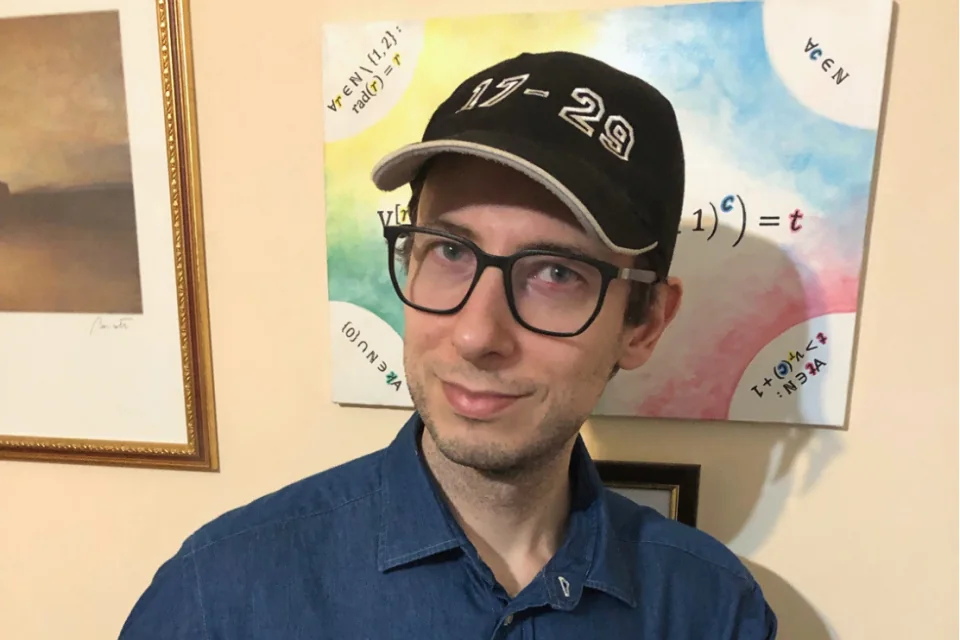
First part of the interview with Marco Ripà, independent researcher in mathematics. He describes how to become a researcher without a linear path: a curiosity for numbers, a method built as a self-taught scholar, and the relationship between potential and skills.
This is the first of two parts, which can also be read separately. In the second part: what changes when artificial intelligence works alongside the person doing research.
Marco Ripà
Independent researcher in mathematics
Marco Ripà is an independent researcher. He graduated with honours in Economics, trained in mathematics as a self-taught scholar and works on number theory, graph theory and multidimensional geometric optimisation problems, publishing in peer-reviewed journals as well as preprints and books. He is the sole author of more than 200 sequences in the On-Line Encyclopedia of Integer Sequences (OEIS). Between 2011 and 2017 he also worked on psychometrics and giftedness, designing dynamic, software-generated cognitive tests. Today he explores the use of artificial intelligence models in mathematical research and, alongside his scientific work, is active in outreach and education, especially through his YouTube channel.
The opinions and interpretations expressed in the interview are those of the interviewee and do not necessarily reflect the position of Starry Mind Academy.
Your path in mathematical research developed through entirely self-taught training. What has fed your interest in mathematics over time, and how did you move from personal curiosity to formulating original research problems?
I believe that the difference between a creative mind that produces publishable mathematics and one that conceives original ideas but remains confined to amateurism lies almost entirely in technique, in experience and in the method used to formalise hypotheses, testing them and deducing a cascade of rigorous consequences from them.
In my case, a passion for numbers has been with me since early childhood: I learned to count on my own and, shortly afterwards, to apply the classic properties of arithmetic operations to do mental calculations, discovering them independently. However, during the first two years of upper secondary school (liceo) I had traumatic experiences with my mathematics teacher and ended up falling out of love with the subject. I only came back to recreational mathematics after 2008, when I had already completed my university studies in Economics and had begun to take an interest in giftedness and psychometrics.
At that time, in any case, mathematics was certainly not at the centre of my interests: I was mainly busy writing a noir novel with a cryptographic background. It was reading some open problems in number theory, together with an interest in integer sequences, that in 2009 rekindled a curiosity I had essentially set aside for years.
The calculator game
That is how I came to connect some of those questions to a game I used to play as a child. Perpetually bored while spending time in my parents' toy shop, I would pick up a calculator and start multiplying integers greater than 1 by themselves, over and over, until the whole screen was clogged with digits and showed an error. Even then I had noticed recurring patterns in the last digits of the strings of numbers that followed one another on the display, but I did not have the technique to develop that intuition mathematically.
The curious thing is that I returned to a similar problem in 2011, but in relation to an operator of a higher order than exponentiation, the so-called "tetration", which consists of building towers of powers. This gave rise to the book La strana coda della serie n^n^...^n ("The strange tail of the series n^n^...^n"; Ripà, 2011), in which I tried to develop some personal intuitions through a mainly empirical approach.
From first intuitions to mathematical research
For several years I remained an amateur mathematician, interested above all in spotting regularities, formulating conjectures and proposing original problems, including through the sequences I was beginning to publish on the OEIS (the On-Line Encyclopedia of Integer Sequences; OEIS Foundation Inc., n.d.). Until the end of 2014, moreover, mathematics was not even my main hobby. Only later, especially between 2018 and 2020, did I gradually develop a more rigorous research method, independently acquiring the tools needed to turn some intuitions into proven, publishable results.
“A path that was anything but linear, during which I also learned a great deal from my mistakes”
Coming back to tetration, in October 2026 a paper I wrote with Gabriele Di Pietro was published (Ripà & Di Pietro, 2026), in which we proved what I consider one of the most characteristic results of my work in number theory. Put simply, we identified exactly in which numeral systems, for all integer bases that meet the conditions set out in the box, the number of final digits that stabilise as the height of the towers grows increases by an increment that eventually becomes constant.
For readers who want the mathematical details: the result on tetration
In short, a problem I had approached as a simple enthusiast, without any real theoretical training behind me, and that only many years later I managed to bring back to a general and rigorous mathematical characterisation.
Working as an independent researcher means finding tools, sources and ways of checking on your own. How did you build your research method, and how do you deal with situations in which a problem resists your attempts to solve it or calls your hypotheses into question?
When I started doing mathematical research seriously, the generative AI tools we know today did not exist. Since I had to learn on my own not only the mathematics I needed, but also how to identify original problems, tackle them and communicate the results, choosing which questions to focus on was of fundamental importance.
Small open problems
My intuition was to do the opposite of what so-called cranks usually do: amateurs who dream big and immediately aim to prove legendary problems without having the necessary theoretical tools. I preferred to look for small open problems that I could tackle with my knowledge, or to find original developments of known results, and then try to generalise them step by step.
In this sense, multidimensional spatial optimisation problems, which can also be approached through graph theory, turned out to be particularly well suited to my ability to recognise patterns and regularities. Some of these questions have a relatively low barrier to entry in terms of the theoretical knowledge required, but they can become extremely complex when you try to move from particular solutions to general, rigorously proven results.
It was nonetheless a perilous process, especially for someone who had to learn everything by himself. Just managing to produce scientific papers in LaTeX (the system in which most mathematics papers are written), in acceptable technical English, takes a certain effort when you have not learned all this through university exams in exchange for university credits. The main problem, though, was certainly not formatting papers: it was learning to develop and present mathematical results according to proper scientific standards.
Putting my hypotheses to the test
Now, granting that mistakes will keep me company for the rest of my life, I feel I can say that experience has allowed me to develop a fairly rigorous method for finding my way through the process that links an intuition to the formulation of a conjecture and, when possible, to its proof.
At first something seems to point in a certain direction, and you begin to suspect that a particular property might hold in general. At that point I first try to refute it, building examples that could violate it; if I cannot produce counterexamples, I consider trying to prove it rigorously. Of course, not finding counterexamples does not mean you have proved anything at all, and distinguishing between a plausible conjecture and a result that has actually been proved is one of the fundamental aspects of research.
This process is often costly and sometimes rather convoluted: when a proof does not seem within my reach, I prefer to focus on intermediate results that I consider more accessible, possibly postponing the main problem. One of the greatest risks, in fact, is that the conjecture is false and that trying to prove it takes weeks or months before you realise you have ended up in a cul-de-sac.
I remember in particular that something similar happened to me in the spring of 2018, while I was working on a manuscript on tetration that was later published in 2020 (Ripà, 2020). I was stubbornly trying to prove a proposition I believed to be true, but I could not close the argument. In the end I resigned myself to leaving it out of the paper. Only a couple of years later did I manage to derive the structure of infinitely many counterexamples, which at first I had not even suspected could exist.
“It is also through experiences like this that I learned not to confuse what seems to work, perhaps after thousands of experimental checks, with what can be proved”
Today I consider the ability to formulate a problem correctly, test its hypotheses and recognise the limits of the results obtained an essential component of my research method, at least as much as the ability to find a possible solution.
You have described a path of independent learning and, in the past, you also studied giftedness and psychometrics in depth. Looking back on your school experiences and your later path in mathematical research, how has your understanding of your abilities changed, and of the relationship between cognitive potential and acquired skills?
At school I found it very hard not to get bored during lessons. I generally found the teaching slow, convoluted and very repetitive, but I still tried to get good results, studying mainly from late afternoon into the evening.
In primary and middle school I struggled a lot to put up with that slow pace. I remember enjoying studying the whole history textbook for the school year within the first two weeks. My teachers were not particularly pleased to see me always with my hand up, ready to give the answers, sometimes before they had even finished the question. Gradually I lost interest in imposed study and began to cultivate passions of my own.
These interests tended to change fairly often, partly because of my neurodiversity: yes, it's true, I'm autistic... ahem, Asperger's, which sounds a bit better, the latest DSM-5 notwithstanding!
Jokes aside, back then I did not really understand how my mind worked, and I often had the impression that something was wrong. Only many years later did I recognise a description of my way of reasoning in the expression "arborescent (tree-like) thinking", which is also used in discussions of giftedness. It held me back a lot in mathematics: I found it extremely hard to spell out logical steps that in my mind were automatic, implicit, and seemed to complete themselves at a subconscious level. It seems strange to admit it, but in the first two years of upper secondary school this made me unpopular with my mathematics teacher and ended up obscuring that little bit of talent and aptitude that might otherwise have emerged already in that context. And, as the icing on the cake, I also suffered numerous episodes of bullying in the state schools I attended on the outskirts of Rome.
Despite this, I finished secondary school with top marks while keeping my intellectual curiosity alive, above all by reading books, studying the classics and exploring on my own the subjects that interested me.
From looking for answers to psychometrics
It was only in the spring of 2008 that I began to ask myself more seriously about my cognitive abilities. One day, after a particularly tiring morning, I looked online for a fun logic quiz or puzzle and came across my first high-range test, a type of test designed to discriminate performance at the upper end of the distribution of cognitive abilities.
I enjoyed solving it and, after just two hours of work, sent my answers to the author. Participants usually take several weeks over challenges like this. Unexpectedly, I obtained a very high score, with ceiling problems (that is, beyond the maximum measurable score) for that test; intrigued, I tried other similar tests by different authors. The results were consistent and led me to look more deeply into giftedness, especially in its most extreme manifestations.
In 2011 I joined Mensa, the best-known international association for people with a high IQ, but from 2008 I had already started joining other high-IQ groups, eventually becoming a member of dozens of associations that are even more selective in terms of percentile. However, beyond the many quizzes for their own sake and repetitive logic games, I did not find there either the kind of ultra-stimulating, scientifically productive intellectual interaction that, deep down, I wanted to develop: I found it later, by tackling challenging open problems in mathematics.
So I began to study psychometrics on my own, partly to better understand myself and others (and then, let's face it, there were numbers, percentiles, statistical distributions, problems of measurement and test construction: all rather entertaining material for an Asperger's mind like mine!).
My interest became serious enough that in 2012 I took part as a guest speaker in an international conference on giftedness and learning, presenting two papers (Ripà, 2012a, 2012b). That same year I began to sketch out the idea of dynamic, equinormed high-range tests generated by software: tests that would change from one administration to the next while keeping the level of difficulty unchanged. With Gaetano Morelli we developed the project of dynamic numerical tests (Ripà & Morelli, 2013), an idea that contributed to the Genius of the Year – Europe award given to me in 2014 by the World Genius Directory (2014). At the end of 2016, with Roberto Enea, we went on to create equinormed dynamic spatial tests, generated by software and designed to be culture-fair (as independent as possible of cultural background).
From potential to skills
Over the years I began to devote less and less time to groups linked to IQ and giftedness, while my interest grew in activities in which I could put to a real test the abilities I had until then tried to estimate. Recreational mathematics, and then mathematical research, took up more and more space, along the path I have already described in my previous answers.
Today I place much more value on the effort needed to become genuinely good at something than on trying to establish who, in the abstract, might be more naturally suited to excel at it.
After all, as a recent book by Hindemburg Melão Jr. (2026a, 2026b) also suggests, having high cognitive abilities, which can help learning in many disciplines, is different from reaching levels of excellence in a specific field. Other factors come into play: the choice of interests, educational opportunities and, above all, the quantity and quality of mental practice sustained over time.
I believe this is especially true in mathematics. I do not think at all that I am an exception to the rule: on the contrary, I am fairly convinced that I have not fully exploited my potential, because in my youth I lacked structured mathematical study and an adequate educational path.
“My experience therefore leads me to draw a clear distinction between cognitive potential and the skills actually developed: the first can foster the second, but cannot replace it”
And then, personally, I find what a person manages to learn and actually achieve far more interesting than trying to quantify their potential abilities.
English translation by Starry Mind Academy, reviewed and approved by the author. Read the original Italian version.
References
Show the 12 references
- American Psychological Association. (n.d.). Autism. https://www.apa.org/topics/autism-spectrum-disorder
- Melão Jr., H. (2026a). The 5,570 greatest geniuses in human history and their IQs. Clube de Autores. https://literaryhighways.com/en/books/the-5-570-greatest-geniuses-in-human-history-and-their-iqs-2
- Melão Jr., H. (2026b). IQs of the 5,570 greatest geniuses in history [Preprint]. SSRN. https://doi.org/10.2139/ssrn.7348160
- National Autistic Society. (2023). Asperger syndrome (Asperger's). https://www.autism.org.uk/advice-and-guidance/what-is-autism/the-history-of-autism/asperger-syndrome
- OEIS Foundation Inc. (n.d.). The On-Line Encyclopedia of Integer Sequences. https://oeis.org/
- Ripà, M. (2011). La strana coda della serie n^n^...^n [The strange tail of the series n^n^...^n]. UNI Service.
- Ripà, M. (2012a). Differentiating features of gifted children and dealing with high IQ societies [Conference presentation]. 12th Asia-Pacific Conference on Giftedness, Dubai, United Arab Emirates. https://www.researchgate.net/publication/233911292_Differentiating_features_of_gifted_children_and_dealing_with_high_IQ_societies
- Ripà, M. (2012b). Identifying gifted children and dyslexia early diagnosis: Risk of cheating on IQ tests [Conference presentation]. 12th Asia-Pacific Conference on Giftedness, Dubai, United Arab Emirates. https://www.researchgate.net/publication/233911336_Identifying_gifted_children_and_dyslexia_early_diagnosis_risk_of_cheating_on_IQ_tests
- Ripà, M. (2020). On the constant congruence speed of tetration. Notes on Number Theory and Discrete Mathematics, 26(3), 245–260. https://doi.org/10.7546/nntdm.2020.26.3.245-260
- Ripà, M., & Di Pietro, G. (2026). A compact notation for peculiar properties characterizing integer tetration. Notes on Number Theory and Discrete Mathematics, 32(3), 477–496. https://doi.org/10.7546/nntdm.2026.32.3.477-496
- Ripà, M., & Morelli, G. (2013). Retro-analytical reasoning IQ tests for the high range. Educational Research, 4(4), 309–320. https://www.interesjournals.org/articles/retroanalytical-reasoning-iq-tests-for-the-high-range.pdf
- World Genius Directory. (2014). The World Genius Directory Genius of the Year Awards. https://www.psiq.org/world_genius_directory_awards/awards.htm
The interview continues
In the second part: research in the age of artificial intelligence, between the power of the tool and human responsibility.
Column · Metadialoghi
Conversations on learning, research and critical thinking
Metadialoghi (Metadialogues) gathers Starry Mind Academy's interviews with people engaged in research and in building knowledge, looking not only at what they do but at how they learn, how they think and how they got where they are.
Interview subject to editorial review. How we work